Strategic Design Decisions: Leveraging Seaweed Silhouettes in Black and White for Brand Impact
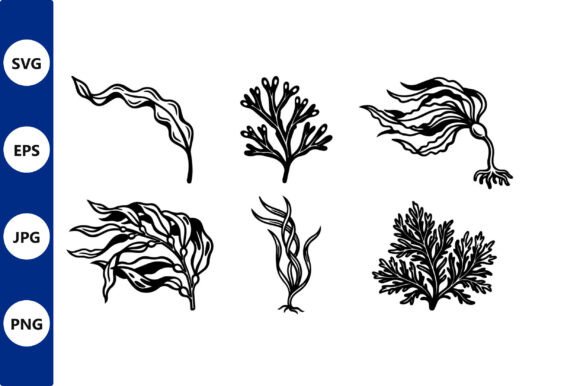
In the crowded landscape of visual communication, clarity is often more valuable than complexity. Designers, brand managers, and creative entrepreneurs frequently face the challenge of conveying organic elegance without overwhelming the viewer. This is where Seaweed Silhouettes in Black and White emerge not merely as decorative elements, but as strategic assets. A vector art collection of black seaweed silhouettes arranged in a grid, each with distinct fronds and branching patterns, offers a monochrome approach to coastal flora that serves specific functional and aesthetic purposes.
The decision to utilize these high-contrast, simplified forms should be driven by intent. Whether you are developing packaging for a skincare line, creating educational materials about marine biology, or designing interior decor for a hospitality space, the utility of these assets lies in their versatility and clean execution. By understanding how to integrate these silhouettes into your broader creative strategy, you can enhance brand positioning, improve production efficiency, and achieve a sophisticated visual outcome.
The Strategic Value of Monochrome Coastal Flora
When we discuss Seaweed Silhouettes in Black and White, we are referring to a specific design language that prioritizes form over color. The removal of chromatic data forces the eye to focus on shape, line weight, and negative space. For brands aiming to project sophistication, minimalism, or scientific accuracy, this reductionist approach is highly effective.
Consider the operational benefits. A vector-based collection allows for infinite scalability without loss of quality. This is crucial for businesses that need to maintain consistent branding across vastly different mediums—from small product labels to large-scale wall murals. The fact that each design is individually cleaned up and optimized means that creative teams save significant hours on file preparation. Instead of tracing rough sketches or cleaning up low-resolution images, professionals can immediately deploy these assets into their workflows.
Furthermore, the monochrome palette ensures compatibility with existing brand guidelines. If your company uses a strict two-color printing process to reduce costs, or if you are designing for substrates where full-color printing is prohibitively expensive, black silhouettes provide a premium look at a fraction of the production cost. This aligns financial prudence with aesthetic ambition.
Applications Across Industries and Use Cases
To maximize the return on investment for digital assets like these, one must identify the right contexts for deployment. The versatility of Seaweed Silhouettes in Black and White allows them to function effectively in several distinct sectors:
- Product Packaging and Labeling: In the beauty and wellness industry, particularly for products containing algae, kelp, or marine minerals, these silhouettes communicate ingredient sourcing instantly. They add an organic texture to minimalist packaging without cluttering the label.
- Interior Design and Home Decor: For creators selling physical products such as custom wall art, decals, or textiles, the high-contrast nature of black seaweed creates striking focal points. The distinct fronds and branching patterns offer visual interest that works well in modern, Scandinavian, or coastal-themed interiors.
- Educational and Scientific Communication: Educators and publishers can use these accurate silhouettes to illustrate marine biology concepts. The clarity of the vector lines makes them ideal for textbooks, presentations, and infographics where precise identification of species morphology is required.
- Branding and Identity: Small business owners in the hospitality sector, such as seaside cafes or boutique hotels, can incorporate these motifs into their logos, menus, and signage to reinforce their location-based identity without resorting to clichéd imagery like anchors or starfish.
Each of these applications requires a different approach to scaling and composition. Understanding the end-use case before selecting a specific silhouette from the grid ensures that the final output meets both functional and aesthetic requirements.
Technical Considerations for Creative Professionals
The value of a digital download is heavily dependent on its technical robustness. This collection includes high-quality SVG, EPS, PNG, and JPG formats, catering to a wide range of software ecosystems. However, choosing the right format is a critical decision point that affects workflow efficiency.
For designers working in Adobe Illustrator, CorelDRAW, or other vector-based programs, the SVG and EPS files are the primary assets. These formats allow for non-destructive editing. You can adjust anchor points, modify stroke widths, or combine multiple silhouettes to create unique compositions. This level of control is essential for creating bespoke designs that do not look like off-the-shelf clipart.
Conversely, for users who may not have access to professional vector software, or for quick implementations in web design and social media graphics, the PNG and JPG files offer immediate usability. The PNG format, with its transparent background, is particularly useful for layering seaweed elements over photographs or colored backgrounds in tools like Canva or PowerPoint.
It is important to note that while these files are optimized, the responsibility for final output quality lies with the user. Ensuring that the resolution settings match the intended print size is a basic but often overlooked step in the production process. A strategic approach involves testing the assets in the final medium before committing to large-scale production runs.
Risks of Unintentional Design Choices
While Seaweed Silhouettes in Black and White are versatile, they are not a universal solution. Using them without clear goals or context can lead to generic or confusing visuals. One common risk is the "clipart effect," where elements appear randomly scattered rather than intentionally composed. This diminishes the perceived value of the brand and can make the design feel amateurish.
Another consideration is cultural and contextual relevance. While seaweed is associated with health and nature in many contexts, it may carry different connotations in others. Ensuring that the imagery aligns with the brand’s narrative and the audience’s expectations is crucial. For instance, using intricate seaweed patterns on a tech product might create cognitive dissonance unless the connection to sustainability or bio-mimicry is clearly communicated.
Additionally, overuse of similar motifs can lead to visual fatigue. If every competitor in the marine wellness space uses identical black seaweed silhouettes, differentiation becomes difficult. Strategic designers will modify these base assets—by rotating, cropping, or combining them with other geometric elements—to create a unique visual signature.
Planning for Long-Term Brand Consistency
Integrating these assets into a long-term brand strategy requires planning. Rather than using them ad-hoc, consider developing a style guide that dictates how and when Seaweed Silhouettes in Black and White are used. Define rules for spacing, scale, and combination with typography. This ensures that whether the asset appears on a business card or a storefront window, it reinforces the same brand identity.
For educators and content creators, building a library of customized variations from these base vectors can save time in future projects. By establishing a set of preferred modifications early on, you create a cohesive visual language that audiences can recognize and trust.
Ultimately, the power of this collection lies in its potential for adaptation. It provides a foundation upon which creativity can be built, but it demands thoughtful direction. By approaching these digital assets with a strategic mindset—considering technical requirements, audience perception, and brand alignment—you transform simple shapes into powerful tools for communication and growth.
Whether you are a freelancer looking to streamline your design process, a small business owner aiming to elevate your product presentation, or an educator seeking clear visual aids, the intentional use of these silhouettes can support your broader goals. The key is to move beyond random decoration and embrace these elements as integral components of a well-planned visual strategy.