Continuous Line Design of Ball: Minimalist Art for Modern Creatives
In an era where visual noise is constant, the power of restraint has never been more valuable. The continuous line design of ball represents a fascinating intersection of artistic discipline and modern aesthetic preference. This style, characterized by a single, unbroken stroke that defines form without lifting the pen, captures the essence of minimalism while retaining a sense of organic movement. It is not merely a drawing technique; it is a visual language that speaks to efficiency, elegance, and clarity.
For professionals, creators, and business owners, understanding this art form offers more than just appreciation. It provides a toolkit for communication that cuts through clutter. Whether you are designing a brand identity, creating educational materials, or decorating a personal space, the simplicity of a single-line illustration can convey sophistication and focus. The trend toward cleaner, more intentional design choices reflects a broader cultural shift away from excess and toward meaning.
The Evolution of Single-Line Aesthetics in Digital Media
The concept of drawing with a continuous line is not new. Artists like Pablo Picasso and Henri Matisse explored these boundaries decades ago, challenging viewers to see form through suggestion rather than detailed rendering. However, the digital age has revitalized this approach. Today, the continuous line design of ball is not just a sketch on paper but a versatile digital asset used across various platforms.
Modern workflows demand speed and adaptability. Vector graphics, which allow images to be scaled infinitely without losing quality, have become the standard for professional design. When applied to continuous line art, vector formats enhance the precision of the curve while maintaining the hand-drawn feel. This evolution meets the current market preference for assets that are both authentic and technically robust. Users no longer want generic clip art; they seek unique elements that feel human yet perform flawlessly on screens of all sizes.
This shift is evident in how brands communicate. Startups and established companies alike are moving away from complex, heavy logos toward lighter, more agile visual identities. A simple, continuous line can suggest motion, unity, and completeness—qualities that resonate with contemporary audiences who value transparency and ease.
Practical Applications for Creators and Entrepreneurs
Why should a marketer, blogger, or entrepreneur care about a specific drawing style? The answer lies in versatility and emotional impact. Visual content is processed faster than text, and distinctive imagery helps retain attention. The continuous line design of ball serves as an excellent example of how a simple element can anchor a larger design strategy.
- Brand Identity: Use single-line icons to create a cohesive set of symbols for your website or app. They load quickly and look sharp on mobile devices.
- Content Marketing: Break up long articles with minimalist illustrations. They add visual interest without distracting from the core message.
- Packaging Design: For physical products, continuous line art adds a touch of artisanal quality, suggesting care and craftsmanship.
- Social Media Graphics: Clean lines stand out against busy feeds, offering a moment of visual calm that encourages engagement.
Consider the psychological effect of these designs. A ball drawn in a single line suggests continuity and flow. It implies that things are connected, a subtle but powerful message for businesses focused on community, logistics, or holistic services. By integrating such elements into your visual repertoire, you align your brand with values of simplicity and integrity.
Expanding the Theme: Nature and Leisure in Single Line
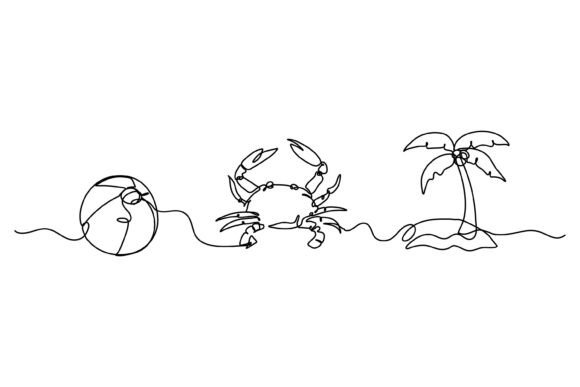
While geometric shapes like balls provide a foundation for understanding the technique, the true potential of continuous line art shines when applied to organic subjects. Take, for instance, the continuous line design of ball, crab and palm on the beach. This composition transforms a simple exercise into a narrative scene. It evokes feelings of relaxation, summer, and escape.
This specific combination of elements highlights the flexibility of the medium. The roundness of the ball contrasts with the intricate legs of the crab and the fronds of the palm tree, yet all are unified by the same unbroken stroke. For designers working in the travel, hospitality, or lifestyle sectors, such imagery is invaluable. It communicates a vibe instantly, without the need for words.
The inclusion of natural elements also broadens the appeal. People are increasingly seeking connections to nature, even in digital spaces. Illustrations that feature beach scenes, flora, and fauna resonate with audiences looking for balance and tranquility. Using a single line to depict these complex forms challenges the artist to capture the essence of the subject, resulting in images that feel both playful and refined.
Technical Formats: Why EPS, SVG, and JPG Matter
When acquiring or creating digital art, the file format is as important as the image itself. Understanding the differences ensures you use the asset effectively across different mediums. Most professional resources will provide a package including EPS, SVG, and JPG files. Here is why each matters:
- EPS (Encapsulated PostScript): This is a standard vector format used primarily in print design. If you are creating brochures, business cards, or large-format banners, EPS files ensure that your continuous line art remains crisp at any size. It is compatible with most professional design software like Adobe Illustrator.
- SVG (Scalable Vector Graphics): Ideal for web and app development, SVGs are code-based vector images. They load fast, are searchable by engines, and scale perfectly on retina displays. For bloggers and web designers, SVG is often the best choice for icons and decorative elements.
- JPG (Joint Photographic Experts Group): This is a raster format, meaning it is made of pixels. While it does not scale well, it is universally compatible and easy to use for social media posts, email newsletters, or quick previews. Having a high-resolution JPG ensures you can share your design instantly without needing specialized software.
By providing all three formats, creators empower users to integrate the art seamlessly into their existing workflows. Whether you are a freelancer sending a proof to a client or a business owner updating your website, having the right file type saves time and prevents quality issues.
Integrating Minimalist Art into Daily Workflows
Adopting continuous line design into your creative practice does not require becoming a master illustrator. Instead, it involves curating the right resources and knowing how to apply them. Start by identifying areas in your current projects where complexity might be hindering clarity. Could a paragraph be supported by a simple icon? Could a header be enhanced with a subtle decorative line?
For educators, these visuals can aid in explaining concepts without overwhelming students. For marketers, they can differentiate campaigns in a saturated market. The key is consistency. Once you choose a style, such as the single-line aesthetic, apply it across your touchpoints. This builds recognition and trust.
Moreover, the process of selecting or creating these designs can be meditative. In a fast-paced work environment, taking a moment to appreciate the flow of a single line can serve as a mental reset. It reminds us that effective communication does not always require more; often, it requires less.
Future Trends in Decorative Elements
As technology advances, the demand for personalized and authentic visual content will continue to grow. AI-generated art is becoming common, but there remains a strong appreciation for human-centric design principles. Continuous line art bridges this gap. It feels handmade, yet it is easily digitized and distributed.
We are likely to see more hybrid approaches, where traditional drawing techniques are combined with interactive digital elements. Imagine a website where the continuous line animates upon scrolling, drawing itself across the screen. This dynamic application keeps the user engaged and adds a layer of interactivity to static design.
However, the core principle remains unchanged: clarity and connection. Whether it is a continuous line design of ball or a complex beach scene, the goal is to communicate effectively. By embracing this style, you position yourself at the forefront of a design movement that values substance over spectacle.
In conclusion, the appeal of single-line decorative elements lies in their ability to do more with less. They are practical, versatile, and aesthetically pleasing. For anyone involved in creation, marketing, or education, incorporating these designs can enhance your output and resonate with your audience. As you explore these resources, remember that the best design is often the one that goes unnoticed because it fits so perfectly into the experience.